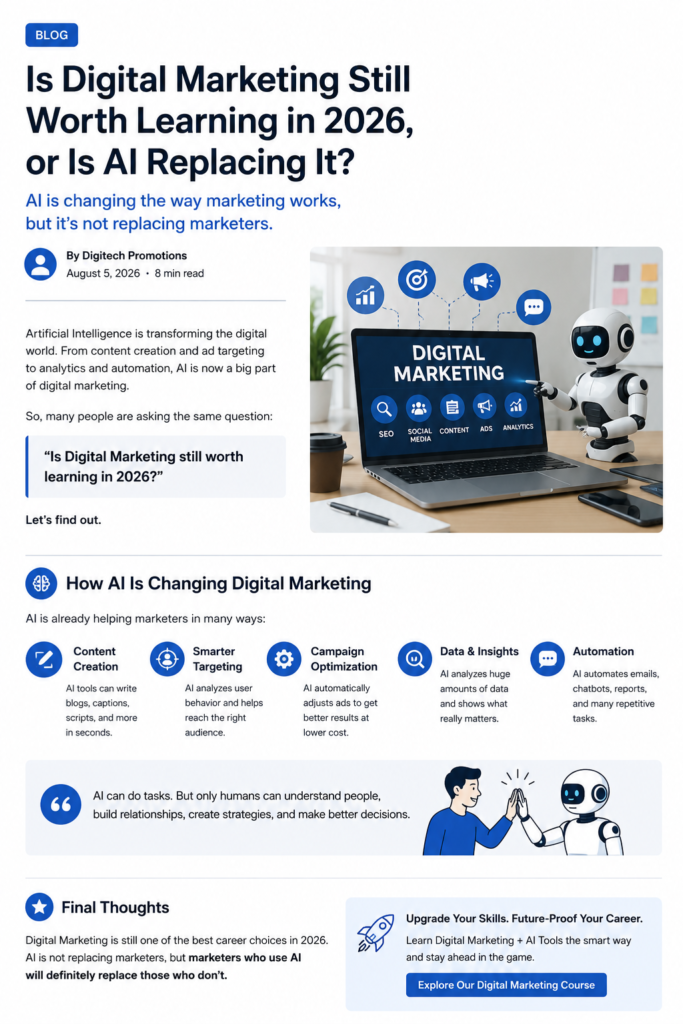
Every few months, a new headline claims another skill is “dead” because of AI. Digital marketing has been on that list for a while now. Ask ChatGPT to write your ad copy, ask another tool to build your funnel, ask a third to schedule your posts — so why would anyone still learn digital marketing in 2026?
Here’s the honest answer: AI hasn’t replaced digital marketing. It has replaced the parts of digital marketing that never needed a human in the first place.
Let’s break down what’s actually changing, what isn’t, and why this is one of the best times in years to learn the skill — not the worst.
Show Image
What AI Has Actually Automated
To be fair to the skeptics, AI genuinely has taken over a lot of ground:
- First-draft content — blog outlines, ad copy variations, captions
- Basic image and creative generation
- Campaign reporting and dashboard summaries
- A/B testing and bid optimization inside platforms like Google Ads and Meta Ads
- Keyword research groundwork
If your idea of “digital marketing” was writing captions and pulling weekly reports, yes — that part is largely automated now. That was always the most replaceable layer of the job, because it was repetitive and rule-based. AI is very good at repetitive and rule-based.
What AI Still Can’t Do
Show Image
This is the part most “AI is taking over” posts conveniently skip.
1. Strategy AI can generate fifty ad headlines in ten seconds. It cannot tell you why your Kerala-based furniture brand should target Kochi and Kozhikode differently, or why your Meta Ads are converting on mobile but tanking on desktop. Strategy requires understanding a specific business, a specific market, and specific customer behavior — context AI doesn’t have unless a human feeds it in, interprets the output, and course-corrects.
2. Judgment on what “good” looks like AI-generated copy is often generic by default. Every brand using the same tool with the same prompt starts sounding the same. Someone still has to know what makes content land for a particular audience versus what’s just technically correct.
3. Platform relationships and real-time changes Google and Meta update algorithms, ad policies, and auction dynamics constantly. Interpreting why a campaign’s CPC jumped 40% overnight, or what an iOS privacy update means for your tracking, still needs a marketer who understands the platform, not just a tool that outputs numbers.
4. Client and stakeholder communication No AI is sitting across the table explaining to a client why a campaign underperformed this month, or negotiating budget, or building the trust that keeps a client for three years instead of three months.
5. Ethical and brand judgment AI doesn’t know when a campaign angle is tone-deaf, legally risky, or off-brand. That filter is still entirely human.
The Real Shift: From “Doing Tasks” to “Directing Outcomes”
The honest way to describe 2026’s digital marketing landscape is this: the job has moved up a level.
A few years ago, being a good marketer meant being good at execution — writing copy, building creatives, setting up campaigns manually. Now, execution is increasingly AI-assisted. What separates a good marketer from a replaceable one is:
- Knowing what to ask AI for, and why
- Knowing when AI’s output is wrong, generic, or off-strategy
- Combining tools, data, and platform knowledge into a coherent plan
- Owning the business outcome — leads, sales, ROI — not just the task
In other words, AI is a very capable junior employee. It still needs a manager who understands marketing to give it direction and check its work.
Why This Makes Digital Marketing More Worth Learning, Not Less
- Barriers to entry for basic execution have dropped — which raises the value of people who understand strategy, platforms, and data on top of the tools.
- Businesses need AI-literate marketers more than ever. A marketer who can combine Google Ads expertise, Meta Ads knowledge, SEO fundamentals, and AI tools is far more valuable than either a “pure marketer” from 2019 or a “pure AI prompt-writer” with no marketing foundation.
- Every business still needs someone accountable for results. AI tools don’t run a business’s marketing — someone still has to decide the budget, the audience, the offer, and read whether the numbers actually mean growth.
- New tools mean new specializations. AI search (like how people now discover businesses through ChatGPT and Google AI Overviews), AI-personalized ad creative, and AI-driven customer journeys are entirely new skill areas — and someone has to learn them early to have an edge.